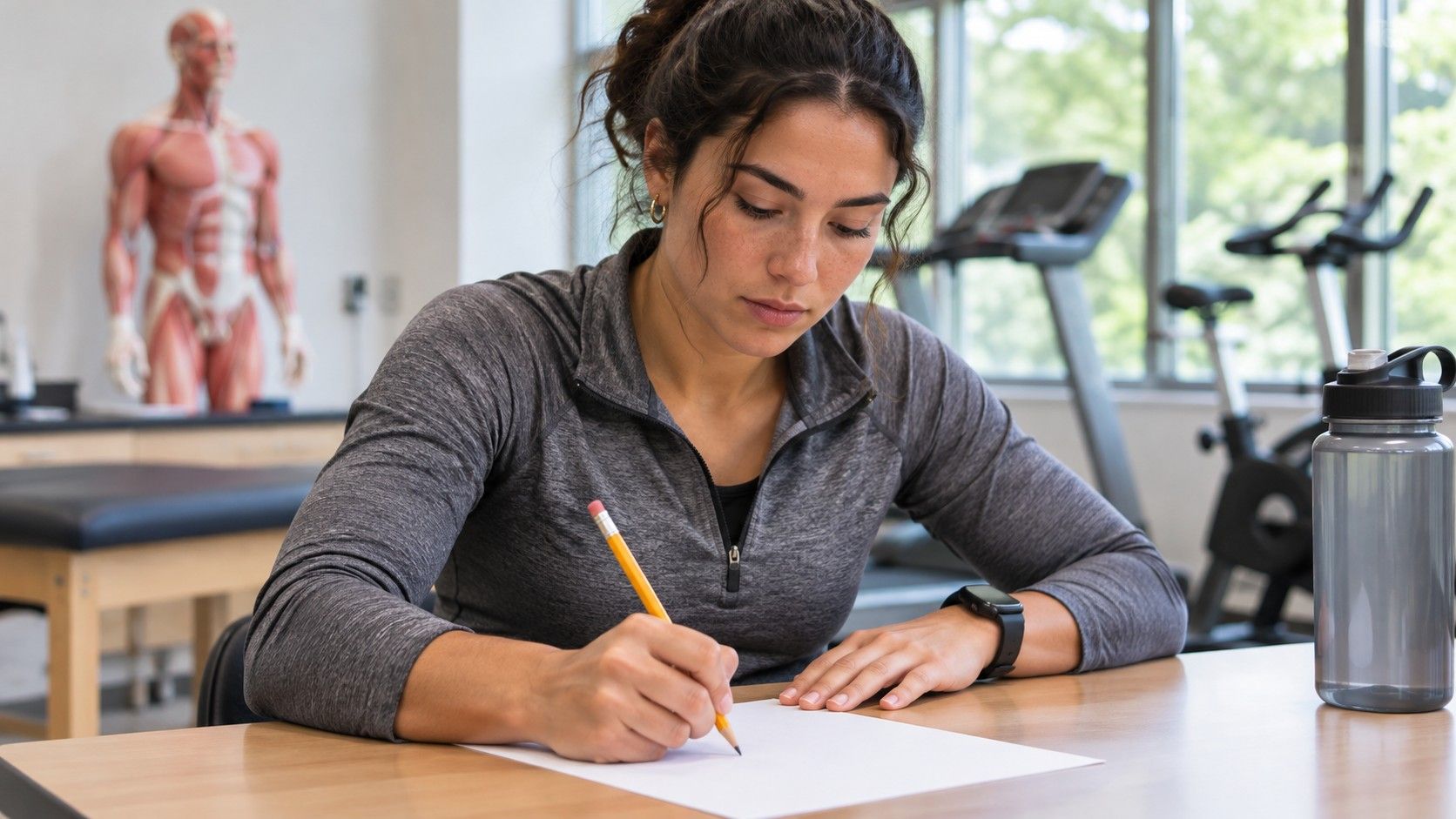
An ACSM-EP exam plan should connect what the examination assesses with what you do each week. Start with the current content outline, keep the candidate handbook beside it, and turn unfamiliar tasks into specific practice rather than measuring progress only in pages read.
Make the content outline your starting map
The outline identifies the knowledge and skills used to build the examination. It is a better starting point than an unofficial list of memorable facts because it shows the scope you are expected to prepare for. Record the version you downloaded and check for an effective date before pairing it with books or courses.
Read each task statement and describe what you would need to do to demonstrate it. A statement about assessment might require choosing a method, interpreting a result, or identifying information that is missing. Those are different learning activities. Converting the statement into a task prevents a familiar heading from being mistaken for mastery of everything underneath it.
Give each task one of three provisional ratings: can explain and apply, can explain with help, or need to learn. Use a short question or a worked example to test the rating. People often rate familiar terminology generously until a scenario asks them to use it. Keep that first audit so you can later compare performance rather than relying on a changing impression of confidence.
Translate weak areas into study actions
A useful study entry has a topic, a resource and an observable outcome. Instead of writing study physiology, specify explain how the relevant response changes the answer in two contrasting exercise scenarios. Instead of revise calculations, specify solve five fresh problems with units shown and explain any incorrect conversion.
Alternate information gathering with retrieval. Read enough to understand a concept, close the source, then reconstruct the reasoning. If you cannot explain why an answer is appropriate, rereading the same paragraph may only increase familiarity. Drawing a simple relationship on paper or talking through a case can reveal the exact gap that another passive reading would hide.
Use the current outline to keep attractive side topics from consuming the week. A fascinating specialist technique may have little relevance to the task you are preparing for. Park it in a separate list and return to the planned objective. The point is not to narrow professional curiosity permanently, but to keep a finite exam-preparation period directed toward an identifiable assessment.
Check examination rules in the handbook
Format, delivery arrangements, identification and appointment policies belong in the candidate handbook or the official registration instructions. They can change independently of the physiology you are learning. Read the current rules before making travel plans or assuming that an old account of another candidate's experience still applies.
Separate the number of questions, available time and scoring rules in your notes. These facts are related but they do not mean the same thing. A scaled passing score should not be converted into a raw percentage without an official explanation. Likewise, the number of practice questions you answer at home does not recreate every feature of the real appointment.
If accommodations are relevant, investigate the procedure early rather than assuming a testing centre can arrange them on arrival. If remote delivery is available for your route, check the published environment and equipment requirements. A quiet room, acceptable identification and a compatible setup are practical conditions, not minor details to leave until the evening before the exam.
Build a rehearsal that reveals decisions under time pressure
Once foundations are stable, use a mixed set of original or legitimate practice questions. Work without notes and record the time spent. Mark questions you answered confidently, guessed correctly, or could not resolve. Those categories matter because a lucky correct response can conceal the same gap as an incorrect one.
Review every uncertain item before looking only at the final score. State which detail in the stem determines the best response and why the closest alternative is less suitable. If the question depends on a numerical result, repeat the calculation with changed values. If it depends on professional judgement, alter one scenario detail and explain whether the preferred response would change.
Do not repeatedly take the same set until the percentage looks reassuring. Familiarity with wording can masquerade as improvement. Introduce fresh examples, vary the order of topics, and revisit missed concepts after a delay. A rehearsal should show whether the reasoning transfers, while your error log should show what to repair before the next one.
Prepare an exam-day routine that leaves room for judgement
A few days before the appointment, confirm the time, delivery method, identification and arrival instructions against the official booking. Check travel or equipment in advance. Keep the final study sessions focused on error patterns and essential concepts rather than trying to replace the whole plan with an exhausting last-minute review.
During practice, establish a simple reading routine: identify what is being asked, extract the relevant information, and compare plausible responses against the stated role and constraints. For a calculation, write the required unit before manipulating numbers. For a scenario, notice whether the question asks for a first action, an interpretation or a longer-term plan. Those prompts can lead to different choices even when the underlying topic is the same.
After the examination, use the official results and next-step guidance rather than rumours about how other candidates were scored. If another attempt is needed, review the applicable retest rules and rebuild the plan around demonstrated gaps. A difficult result should generate specific corrective actions; it should not automatically lead to buying every available preparation product.