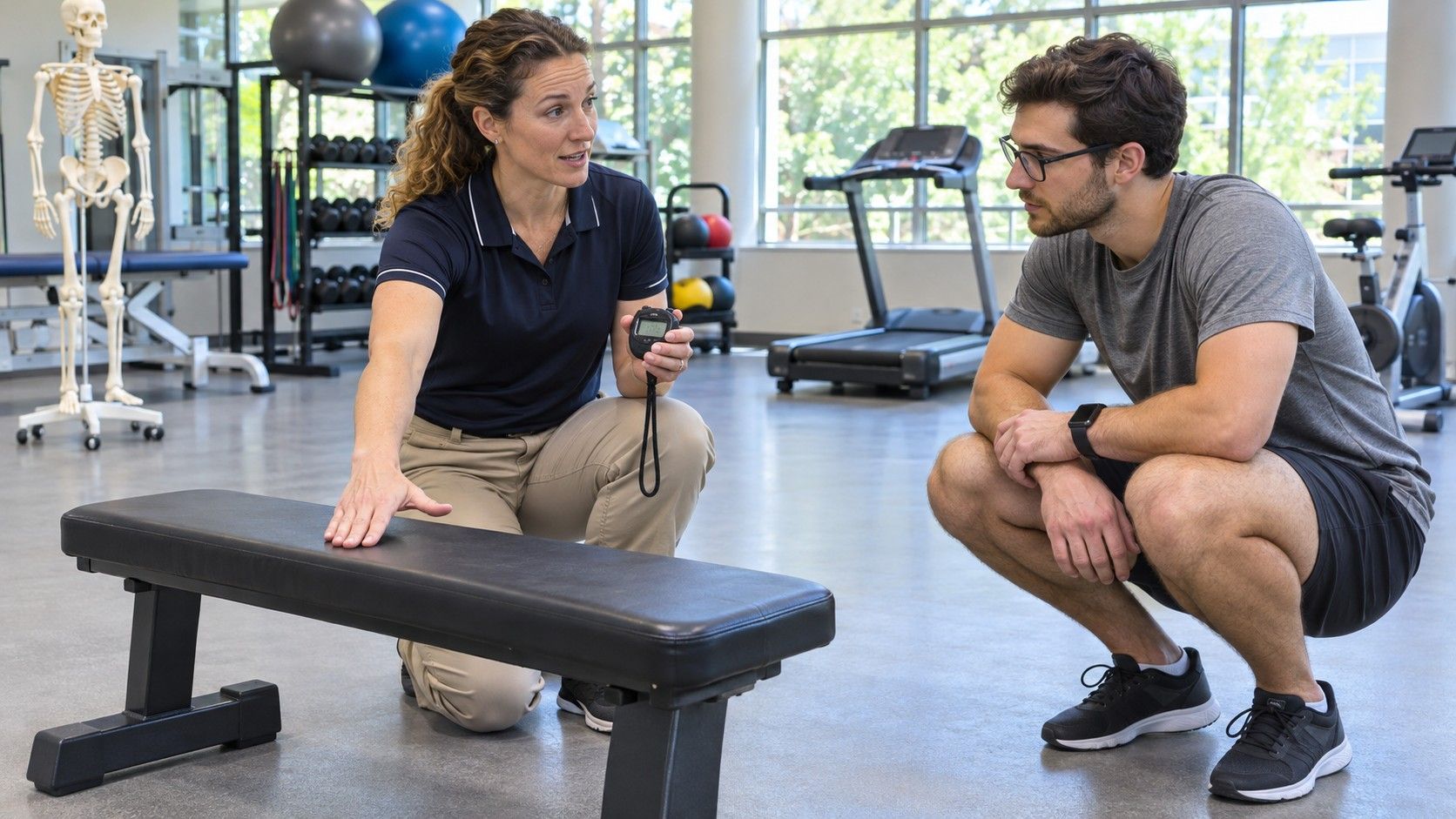
Fitness assessment questions often test whether you can choose a useful measure and interpret it within its limits. Knowing the name of a test is only the beginning. In an ACSM-EP learning scenario, connect the client's goal, the assessment conditions and the decision that the result is meant to support.
Read the purpose before selecting the method
A test is useful when it measures something relevant to the question being asked. If the goal is to track a particular physical capacity, choose an appropriate assessment for that capacity rather than the instrument that happens to be closest. The most technically elaborate option can be the wrong answer when it does not address the stated goal.
Identify the population and practical constraints supplied in the scenario. Consider the person's experience, the information available and the conditions under which the assessment would be performed. Do not add an unstated history to make a favourite method fit. A question may deliberately include several plausible tests and expect the goal or constraint to distinguish them.
Write a short justification before looking at an answer explanation: this method is suitable because it measures the relevant feature under the conditions described. Then identify one reason an alternative is less suitable. That comparison forces you to connect method and purpose. Memorising a list of tests without this connection can leave you unable to choose between them in a new scenario.
Separate screening from performance measurement
Screening and fitness measurement have different purposes. Screening helps establish what information or action is needed before the proposed activity. A fitness assessment measures a defined attribute under an appropriate procedure. A good result on one test does not automatically answer every screening question or remove the need to consider new information.
In a learning scenario, notice the stage at which the professional is working. If essential information is missing, proceeding to measurement may be premature. If screening has already been completed and the question provides no new concern, the task may instead be to select and conduct an appropriate assessment. The sequence in the stem matters.
Avoid interpreting the word assessment as permission to diagnose. An exercise professional can observe, measure and communicate within the role without claiming to establish the cause of every unusual result. When a scenario requires referral or clarification, the reasoning should explain the boundary rather than turning an uncertain observation into a medical label.
Standardise the procedure before comparing results
A comparison is easier to interpret when the conditions are consistent. Instructions, warm-up, equipment setup and measurement technique can influence a result. If these change between sessions, an apparent improvement may reflect the procedure rather than the participant. Record enough detail to make a repeat assessment meaningfully comparable.
Consider a hypothetical test repeated after several weeks. If the second session uses a different protocol and unfamiliar equipment, the numerical difference cannot automatically be attributed to training. The appropriate interpretation should acknowledge that limitation. A confident conclusion is not stronger simply because it avoids uncertainty.
Reliability concerns consistency, while validity concerns whether the measure serves its intended purpose. A method can be consistent yet poorly matched to the attribute you want to assess. Conversely, a relevant method can produce noisy results if the procedure is poorly controlled. Practice questions become easier when you keep those two issues separate rather than using the terms as interchangeable signs of quality.
Interpret the number alongside its context
A result should be read with the unit, procedure and comparison basis attached. A bare number can be misleading when it comes from a different protocol or is compared with an unsuitable reference. Before labelling a performance high or low, ask what the reference represents and whether it is appropriate to the person and method described.
Distinguish a change from a meaningful change. A small difference may fall within ordinary measurement variation or reflect a condition that was not controlled. The question may not provide enough information to decide significance confidently. In that case, acknowledging the limitation and identifying the additional information needed is better reasoning than inventing a threshold.
Communication should preserve this context. Rather than saying the participant is better in every respect, explain which measured feature changed and what cannot be concluded from it. One assessment does not establish every aspect of fitness. A useful interpretation supports a specific next decision, such as reviewing a programme goal or repeating a questionable measure under consistent conditions.
Practise the full chain from choice to explanation
Use an original scenario: a participant wants to know whether a programme has improved the capacity targeted by a repeated test. First name the goal, then select a relevant measure, state the conditions needed for comparison and describe how you would explain the result. This sequence checks more than whether you recognise a test name.
Now change one detail. Suppose the follow-up measurement uses a different procedure, or the participant misunderstood the instructions. Explain how that changes the confidence of the interpretation. If your conclusion stays identical despite a major change in measurement quality, review whether you are paying enough attention to the evidence.
Keep an error log that separates selection errors, procedure errors and interpretation errors. A selection error calls for comparing methods against goals. A procedure error calls for attention to standardisation. An interpretation error may require reviewing units, reference information or uncertainty. Targeted repair is more useful than rereading an entire assessment chapter without identifying which part of the reasoning failed.